Symi Summertime Blues

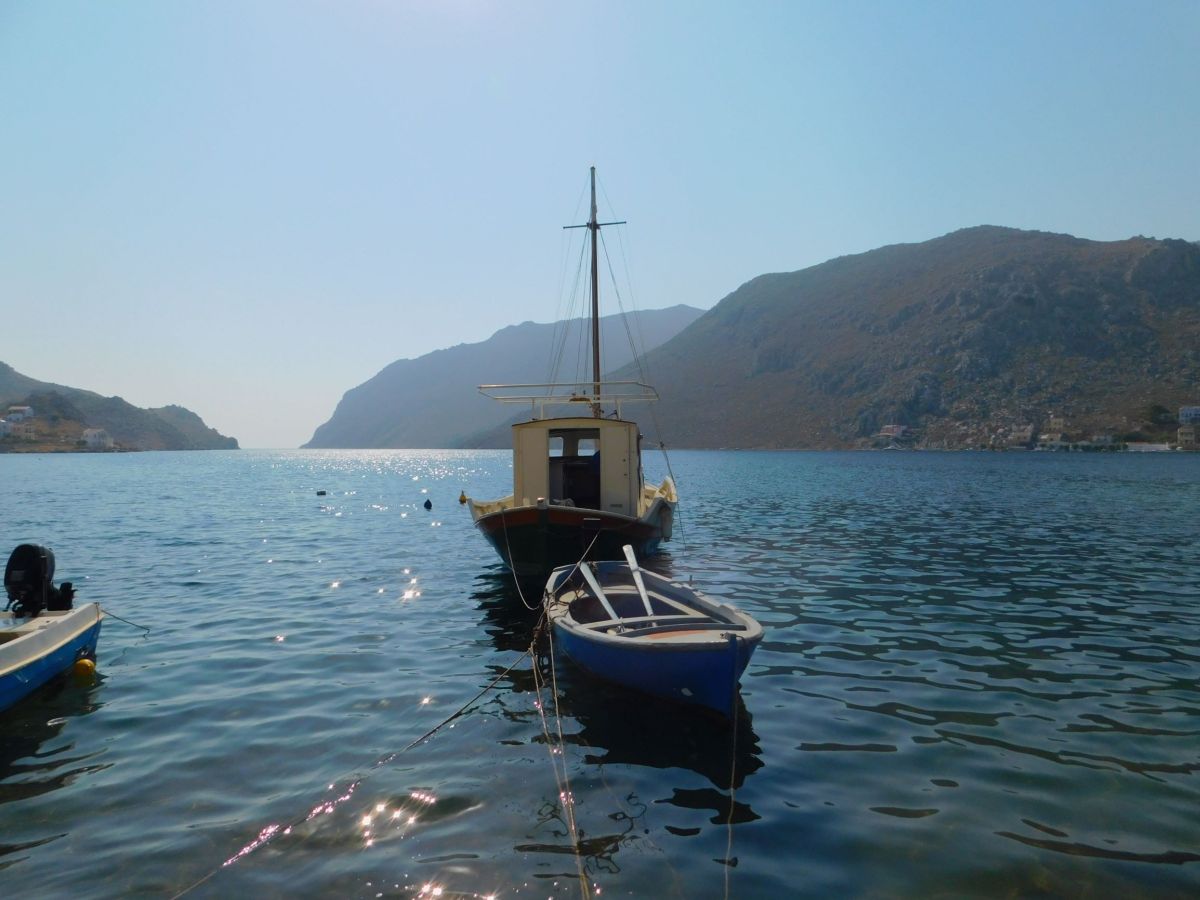
Well, here we are in July. The days are long, the sun is hot, the sea is warm. Normally this is high season and the bay is full of yachts swinging at anchor and Yialos full of gulets and gleaming megayachts. This year both are empty.  There are still restrictions in place regarding yachting movements, many cruising yachtsmen are in the vulnerable over 70s demographic so reluctant to travel, flights have to be booked, anti-fouling applied, boats launched – it will take a while for the summer time parade of visiting yachts and gulets to appear, if it ever does this year.  At the moment, due to Covid-19 testing protocols, Symi is not a port of entry for non-Greek yachts so even if sailing between Greece and Turkey were to resume, it would have to be through Rhodes.

Katsaras in Pedi has been open for a while, as you will have gathered from previous blog posts, and the sunbeds are also out at St Nicholas, even though the water taxi is not running as yet.  Apostoli’s is now making the transition from boatyard to waterfront taverna.  The last of the caiques is in the water and the bobcat is landscaping the beach.  The chairs and tables are getting a lick of paint and the sunbeds are ready to roll.

The Pedi Beach hotel is still pretty much deserted although I saw a pink bathing costume hanging out to dry from one of the umbrellas (sorry, no photo, my batteries were flat).

The general trend at the moment is that the old people head for the sea early – 7 a.m. or thereabouts – and time their walk back up the hill before the heat nails them to the tarmac.  From about 4 p.m. on wards the younger locals make for the water – parents with small children, groups of teenagers, local teachers and so on.  In the middle of the day it is just far too hot at the moment for anyone to move.  Temperatures are in the 40s and only the cicadas are busy.

There is some anxiety on the island at the moment.  In the usual state of Covid-induced paranoia, the news that two Greek-Americans who managed to get to Karpathos in June became ill with Covid-19 after their arrival, infected several relatives before they themselves were isolated in hospital in Crete and resulted in an entire village being put into lockdown has not gone down well.  This was followed a few days later by the news that of the 9 new cases of Covid-19 announced yesterday, 7 of them were tourist arrivals from abroad, and the land border with Serbia has been closed due to an increase of cases there.

Meanwhile, as I write this, my laptop has just pinged a notification that will bring joy to the hearts of any readers from the UK who have flights booked for this month.

Good luck!  Who knows what tomorrow will bring?
A Waiting Game

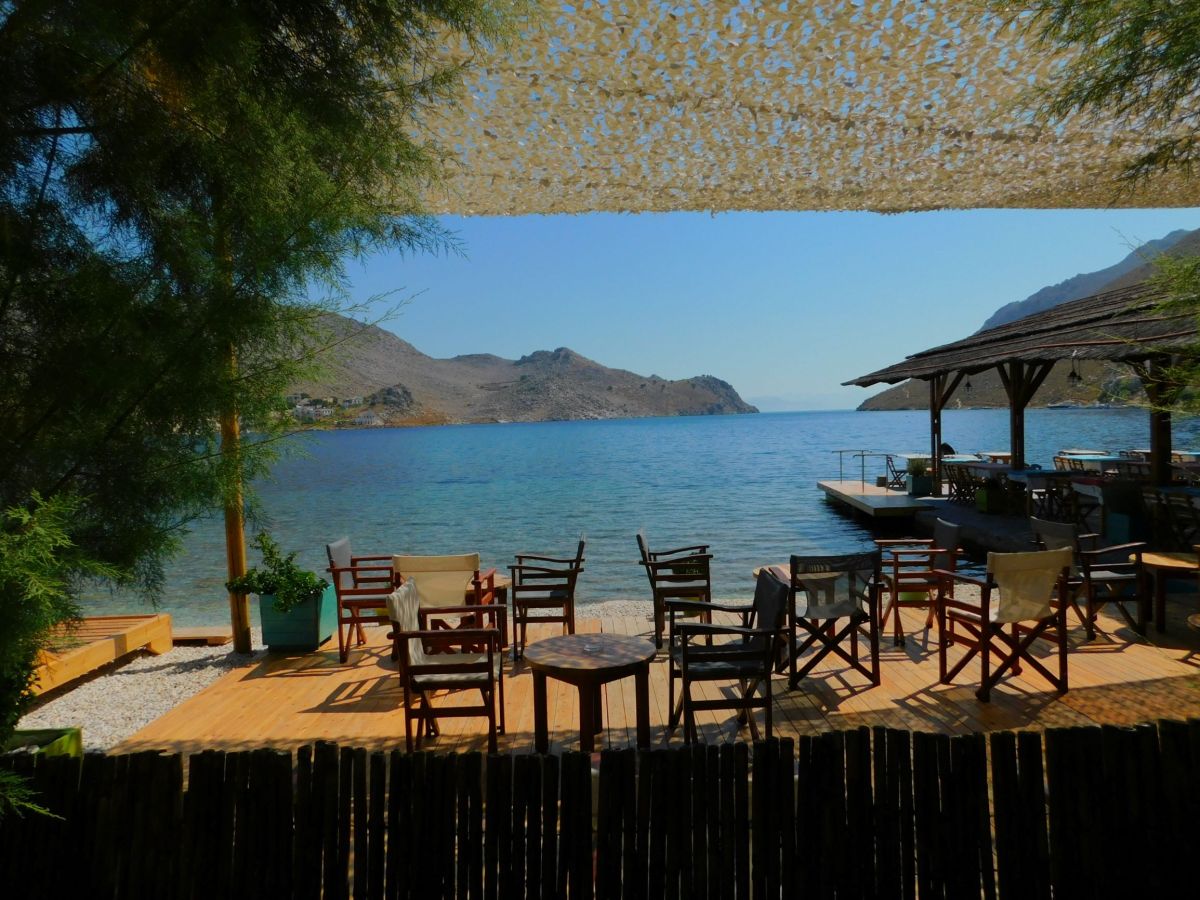
Symi is very quiet.  A few Greek tourists.  A handful of foreigners from ‘safe’ low risk destinations.  Bored local teenagers whizzing up and down the road, sound systems blaring.  Pensioners watering their vegetable plots and grandmothers taking an early morning swim.  The temperature continues to rise and every afternoon there is a gentle migration to the sea to cool off.  Locals play at being tourists as they have little or no work and nothing much to do.  Very few places are open, and those that are, are generally empty.  The cicadas chirp on regardless.

The harbour is devoid of day-trippers.  There are no water taxis bustling in and out of Yialos.  All dressed up and no where to go.

The Greek domestic airports opened to direct flights from other EU destinations and 13 third-party ones yesterday. This comes with all sorts of provisos and restrictions which you can find here.  As you probably know, direct flights from the UK, the USA and Sweden are still forbidden due to the very high levels of infection in those countries.  They may be major contributors to Greece’s usual annual tourist income, but the risks outweigh any possible benefit, particularly as a number of recent cases have been linked to people coming in from the USA and UK via various roundabout routes.

What seems to be more of a problem is that would be travellers from countries that ARE on the approved list are being messed about by various airlines.  For instance, Danes booking with Spies for holidays in September, which is two months away, are having their flights cancelled on the grounds that there is insufficient demand.  Well, if they still have two months in which to sell tickets and people are only just starting to make plans, why cancel flights now?  That only creates a self-fulfilling prophecy.

Fear of making plans and then having them cancelled, often at short notice (vis a vis those who were booked on flights from London for 1 July who were only informed on 30 June that they were cancelled) and fighting to redeem vouchers and refunds from flights cancelled earlier in the year are certainly putting people off travelling, even if they have already had – and recovered from – the dreaded virus.

The Greek government has put all sorts of measures in place to make travel as safe as possible.  Everyone travelling to Greece has to complete an on line Passenger Locator Form 48 hours before travelling, answering a lot of questions regarding where they have been for the past fortnight and who they have met as well as providing accurate details of where they will be staying on arrival in Greece.  Based on this information they are issued with a QR code to present on landing.  This determines whether they will be tested or not.  Other passengers will be subject to random testing.  There is more information about this on the links above.  By the way, the penalties for providing incorrect information are hefty and if you haven’t completed the form and received the QR code, you aren’t allowed to fly anyway.

Quarantine hotels have been established in various towns around the country so anyone, whether Greek or foreign tourist, can be isolated if not sufficiently ill to require hospitalisation.  On Symi the Chorio clinic is designated an isolation unit and anyone who falls ill with the virus will be helicoptered to Rhodes. (Apologies for the Facebook link, unfortunately this video was not uploaded onto the more widely accessible YouTube.)

Unfortunately the dearth of tourists on Symi has severe implications for the Symiots themselves.  Apart from pensioners and those in the merchant navy or working for the banks, power station and so on, everyone else is dependent on tourist revenues of one sort or another to pay the bills and put food on the table.  Whether it is foreign property owners or tourists staying in hotels and short stay accommodation, it is the money coming in from outside that keeps the island’s economy moving.  Greece does not have a well-developed welfare state to help people over the hard times – historically the solution has been mass migration rather than state intervention – and the Covid-19 crisis has lasted far longer than the government had initially anticipated.  If you are able to travel to Symi this year, even if it is for a few weeks much later in the year, please do.  It is going to be a long wait for those who have had no income since October 2019 if they have to wait until the spring of 2021 before they start earning again and by that time many of your favourite haunts may well have shut down permanently.


Greece Welcomes the World?

blog 16 June 2020 a
The water taxis are ready and waiting.

blog 16 June 2020 bblog 16 June 2020 c

blog 16 June 2020 d
Boatyard chick.
blog 16 June 2020 e
Not quite ready for lunch customers just yet.
blog 16 June 2020 f
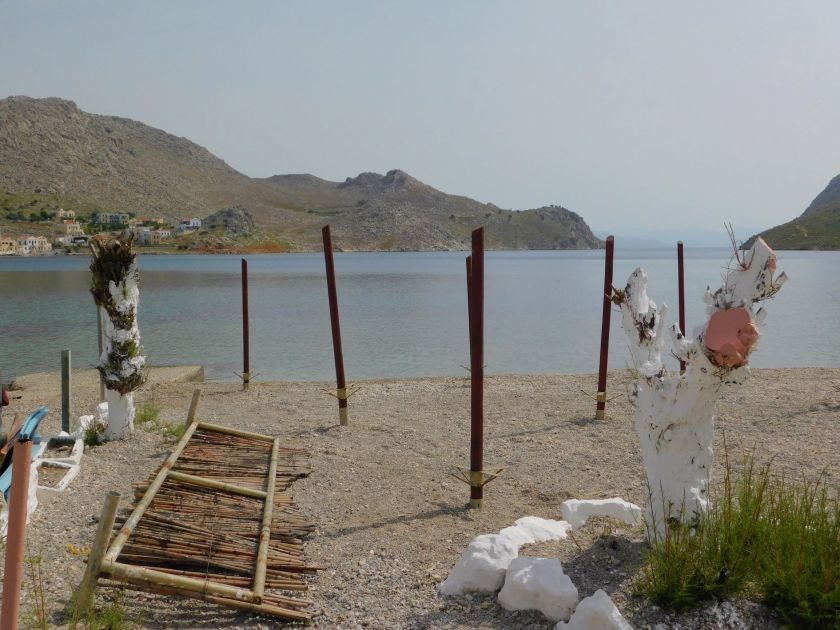
A work in progress – all the boats are back in the water and it is time to transform the littoral into a beach.
blog 16 June 2020 g
High water levels in Pedi as the solstice approaches.

With much fanfare and a Santorini sunset TV op, Greece’s prime minister Kyriakos Mitsotakis declared the 2020 tourist season open.  As is the norm this year, confusion prevails regarding who can travel and what is happening regarding Covid-19 testing and quarantine.  With regulations changing daily and the difficulties the media are having in keeping up to date with the ever-changing landscape, the most reliable source of information on who can travel and what should be happening on arrival is the Ministry of Foreign Affairs website.  This, of course, does not mean that the Ministry of Tourism and the Ministry of Health might not have other ideas but it is a good starting point.

The current measures and lists only really apply to the situation from now to 30 June.  1 July is supposed to see a major opening up to broader international travel but this is highly dependent on how things go in Greece in the next two weeks and also what happens in countries like the USA and the UK where the disease figures are still high.  Greece is treading a fine line between the tourist revenue it desperately needs and destroying brand Greece’s reputation as a safe destination if the virus starts to arrive in significant numbers from abroad.

Tourists themselves are also faced with an ethical dilemma – do I travel because I want to have my holiday and I put my own pleasure first or do I wait until next year in order to protect the health of my hosts?  Many of Symi’s regular visitors, as well as property owners, are discussing this at some length on social media and the general feeling is to stay away until it really is safe to travel, not just because some bureaucrat says so.

Seasonal resort hotels, museums and brothels opened their doors from yesterday.  Gyms have also been allowed to reopen.  Once again, all sorts of new rules, regulations and protocols apply.  The Pedi Beach Hotel has all its umbrellas set up at the new spacings. They had a few Greek guests over the weekend but I didn’t see anyone on my walk this morning, just a lone painter on an extension ladder.

Once again ‘wait and see’ is the motto of the day.

And in other news, temperatures on Symi are now around 30 degrees at midday, dropping to about 20 at night.  After a few exceptionally clear days the heat haze is building up and Saharan sand is drifting up over Crete and the mainland, bringing high temperatures with it.

Keep safe everyone.


Socially Distant Symi

Carnival, Clean Monday Easter and May Day came and went discreetly during the Covid-19 lock down. The same cannot be said for Greek Pentecost which was celebrated with great enthusiasm last weekend. The first holiday since Epiphany in January that could be celebrated in any way, Greece saw its first real surge of domestic tourism.

In Mykonos, the famous party island, Athenians flocked to the beach bars that had opened for that weekend.  The inevitable happened and at least one was fined 20 000 euros and closed for 60 days for violating the social distancing regulations.  Symi, on the other hand, was a place of pilgrimage and Dodecanese Seaways brought people over from Rhodes to go to Panormitis monastery.  Rather more sedate and the photographs emerging on social media were nothing like the jam-packed throngs we usually associate with events like the Panormitis festival or even Sunday church-goers from Rhodes.  Those tavernas and cafes in Yialos that have opened finally had some customers and there was a bit of an ambient hum to the island that has been absent since last summer.

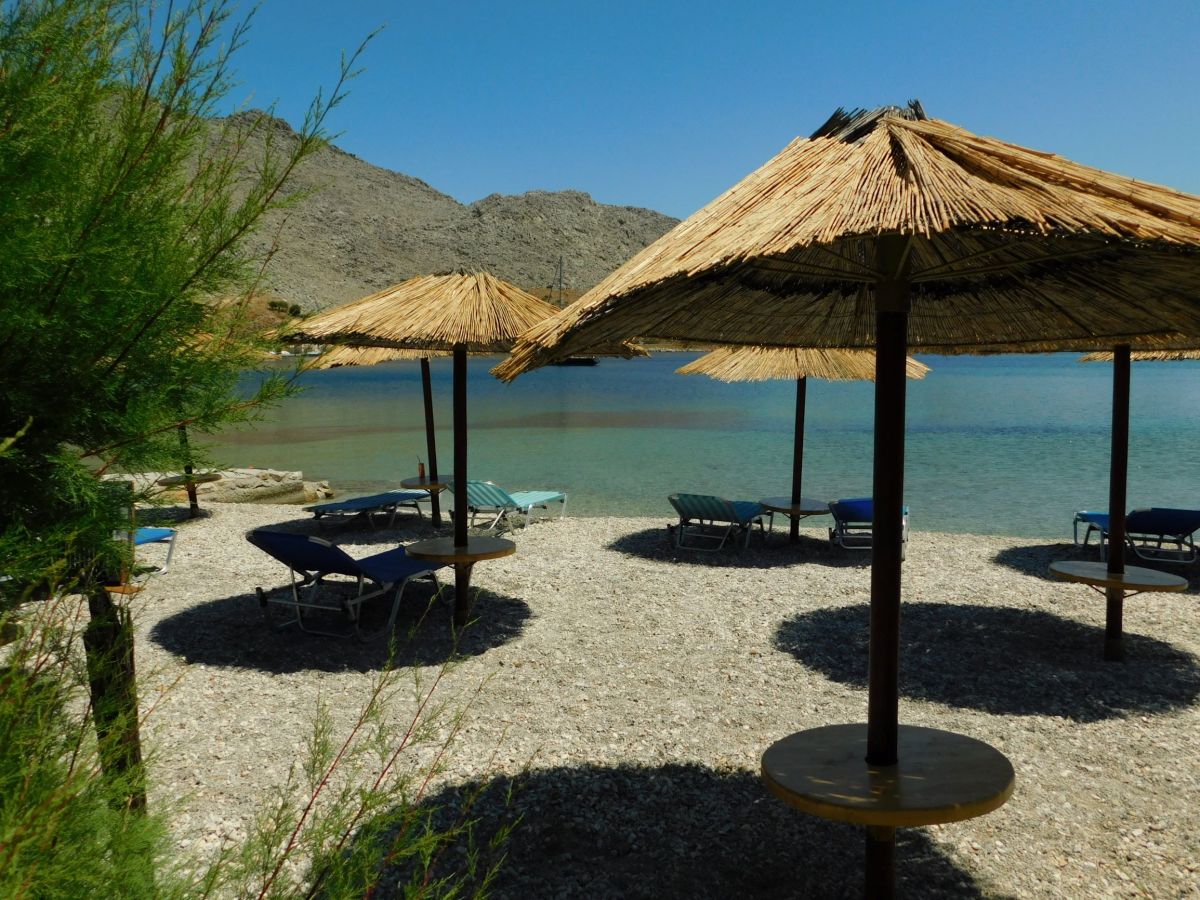
Katsaras in Pedi is one of the few organised beaches that is open at the moment.  As you can see from the photographs, the umbrellas and sunbeds are widely spaced.  The beach has been extended slightly seaward with more sand so that the front row of sunbeds is further out that usual.  The taverna is now open.  Apostoli’s on the other side of Pedi bay is still in boat-yard mode although most of the boats have now been launched.  Locals go along and help themselves from the pile of sunbeds in the corner.

Although the water taxis are being launched none of them is in operation as they don’t have their 2020 licenses as yet and in any case there isn’t really anywhere for them to go until the beach tavernas open and there are enough tourists to justify the service.  The beach and taverna over at Toli bay on the west coast of the island opened for Pentecost but that is accessible by road.

At time of writing, the Nireus, Aliki and Pedi Beach hotels are still closed.  Of these, the Pedi Beach looks the most promising as work is continuing on upgrading the rooms and there are staff around, doing things, even if the hotel is not actually open.

No word about what is or isn’t happening at Agia Marina.  No signs of any activity at Petalo.  NOS beach, the town beach, is not open yet but there is activity going on.

Technically the 2020 international tourist season starts from 15 June which is next Monday and travellers arriving from the approved list will not be subject to quarantine measures, only random spot checks.  All international flights will still be going through Athens.  Local airports like Rhodes will only start receiving international flights from 1 July.  Travel between Greece and Italy is supposed to start opening up from next week, although some Italian airports are still on the high risk list.  Main arrivals are likely to be on the big Super Fast ferries coming from Ancona.   All ferry travel, both domestic and international, requires the completion of a special form before departure, answering various questions regarding health as well as providing contact details and addresses so that in the event of anyone having the virus, all likely contacts can be traced and notified as quickly as possible.  Speaking of ferries, Symi won’t have daily ferries until the Panagia Skiadeni comes on line on 30 June to fill some of the gaps.  This is dependent on there being enough tourists in Rhodes to justify day excursions from Rhodes to Symi so there is a strong element of wait and see there.  The word in the harbour is that we won’t be seeing the ANES Sebeco shuttle this year.  Apparently it is most likely going to serve a potentially more lucrative route off the the mainland.  Of course as this is the year where no one really knows what is happening from one day to the next this may well change.

No one knows for sure yet what countries will be allowed in without any kind of quarantine requirements after 1 July as so much depends on epidemiological profiles elsewhere and these change daily.  There is also concern at all levels because there has been an increase in the number of new cases of Covid-19 in the last 10 days or so, many of them associated with arrivals from abroad (Greeks returning rather than tourist travellers).  The daily government briefings on TV have been reinstated and the situation is being monitored closely.  Specific areas may be isolated or locked down if there is any danger of them escalating into hot spots.  Qatar airlines is only allowed to resume flights into Athens after 15 June as a flight from Doha on 1 June had 12 positive cases out of 91 passengers.  Emirates only resumes on 15 July.  Other airlines are cancelling or rescheduling flights as they go, depending on changing regulations and reduced demand.  I have been receiving emails from mainly British regular visitors to Symi, telling me that their holidays have been cancelled or that they have been rescheduled.  With the UK now implementing a 14 day quarantine period for travellers returning from abroad, it is not surprising that the UK package holiday companies are cancelling June and July holidays on a rolling basis.

Once again, all we can do is wait and see – and do our bit to maintain social distancing to keep ourselves and others safe and well.


Coming Out of Quarantine

On Monday 4 May the first steps began to ease up on the measures first implemented on 29 February to contain the spread of Covid-19 in Greece.  We no longer have to send an SMS or carry a permit to be allowed out of our homes – unless we have just returned from somewhere else in which case the strict 14 day police-controlled quarantine still applies, in which event no amount of paperwork allows you out until the days are done.  Smaller shops where numbers can be easily controlled have been allowed to re-open. This includes bookshops, electronics shops, hardware shops, shoe shops and clothing shops.  In the case of the latter, strict regulations are in force to prevent clothes from being contaminated and you really need to know your size as trying things on is not allowed at this point.  More shops will be allowed to open on 11 May.

Masks must be worn in enclosed places including public transport such as buses, trains, the metro and so on.  This last isn’t much of an issue on Symi.  The bus has been mothballed for the duration and Lakis is using one of his hire cars – with one passenger at a time, travelling on the back seat.  Unnecessary journeys are still frowned upon and it is not permitted to travel between islands or outside ones prefecture for the time being.  Drivers are now allowed to have two passengers in their vehicles now, instead of one.  Gatherings are still limited to a maximum of 10 people and are generally still discouraged.  We can go swimming but not at organised beaches and not in large groups.  There are still restrictions in place regarding private boats and amateur fishing as the authorities don’t want anyone sneaking off to other islands or travelling illegally between the mainland and the islands, potentially taking the virus with them.

15 May is the day when it will be decided how the country goes forward as by that point it will be clear if there has been an up-tick in infections as a result of increased mobility and social interaction.

Restaurants and cafes may be allowed to open on 1 June, if all goes well. This would be with reduced clientele, greater spacing between tables and strict hygiene measures in place.

As things stand at the moment, all-year-round hotels should be allowed to reopen on 15 June and international hotels on 1 July.  These dates, however, have not been confirmed and are dependent on how the figures run.  There are also no firm dates for when international tourism will resume.  Although tourism is responsible for about 20% of Greece’s economy and, in the islands, practically the only significant source of revenue, re-opening the doors to foreign visitors also brings with it the potential threat of a ‘second wave’ of infection which could be much harder to control.  The quality of the tourist product also has to be considered – would people still come if they can’t go clubbing in crowded Mykonos nightspots or line up like sardines in a row on organised beaches?  Perhaps this will be the year the tide turns back to the things that are uniquely Greek – history, culture, archaeology, museums – things which cannot be found elsewhere and which can, actually, be easier to make safe for visitors and locals alike. Only time will tell.

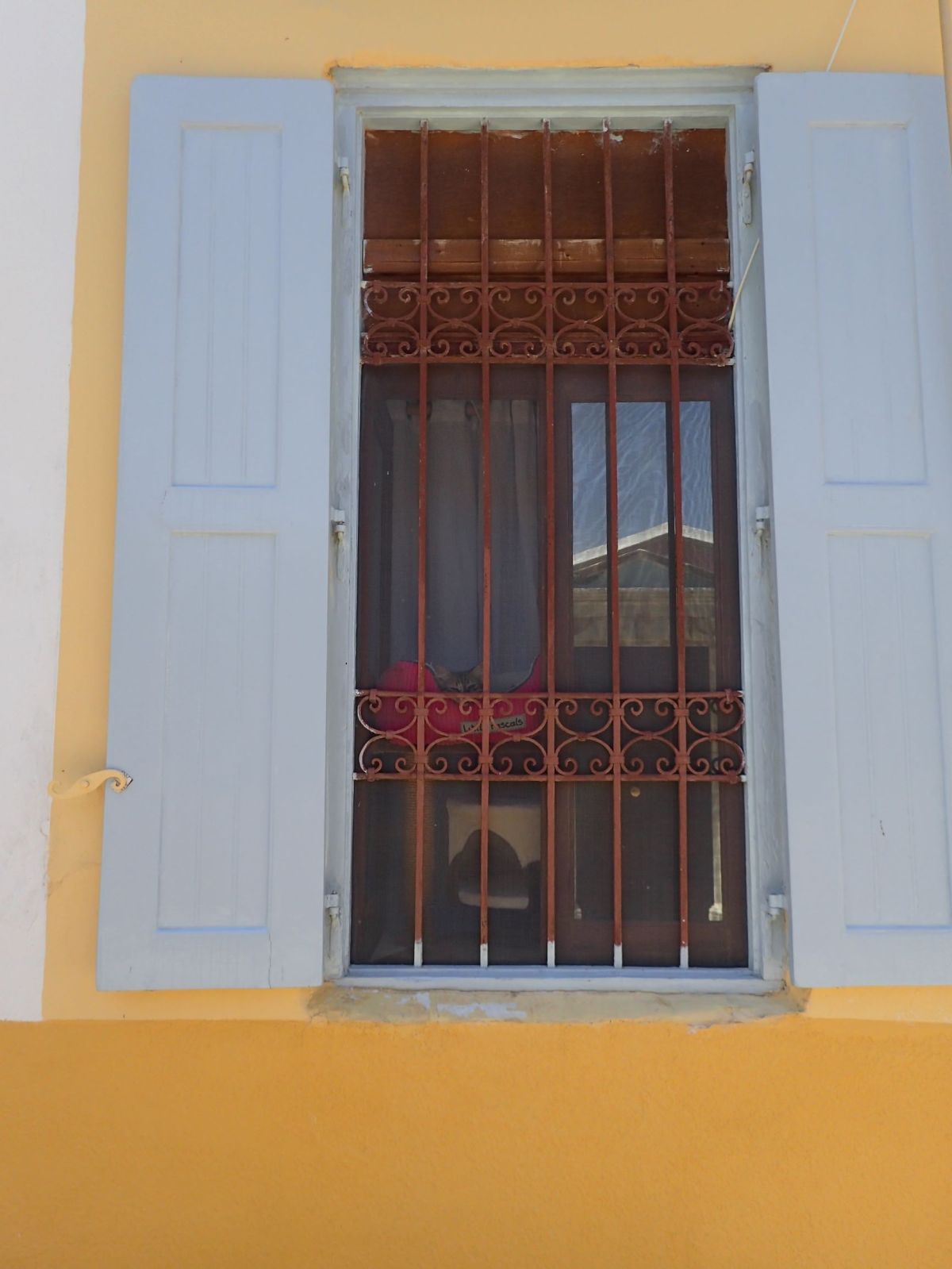
If you look carefully at the photograph, there is a cat, suspended in a special cat bed so that it can look out at the passing parade.  At the moment I think many of us feel like that cat.  Watching to see what happens next before we venture back out into a world that is likely to be very different to the one we saw in on 1 January 2020.

Life on Symi in Self-Isolation

Here we are on our little island, waist deep in daisies, chamomile fragrant under foot and the hillsides pungent with sage blossom.  When I first came here in the mid-90s March was already a fairly busy time, with walking groups, photographers and artists revelling in the spring spectacle.  This slowly faded away as the tourist season contracted and in recent years Symi has been quiet well into May.  In that sense things don’t feel too different to last year or the year before.  In others, however, the change is dramatic.  No more shopping trips to Rhodes.  No more sociable coffees in cafes.  The old boys can no longer hang out at the cafeneions.  They hang out in their vegetable gardens instead and if the tourist season fails totally a lot of people will be dependent on the family orchard and vegetable plot.  The hairdressers, hardware stores, builders’ merchants and other stores are all closed.  Only supermarkets, bakeries, pharmacies, the bank and the agricultural suppliers are allowed to remain open.

I was going to post yesterday but kept delaying as we were all waiting to find out if the speculation in the press that the international flights would be stopping with effect from Sunday would be confirmed. So far, however, this has not been made official.

What has been made official is that ALL hotels, not just the seasonal ones for tourists, have to close on Monday until at least the end of April. This was announced at the same time as a fiscal package to help the country get through the difficult times ahead.  Something else that is official is that anyone arriving into the country now has to go into enforced 14 day quarantine.  They have to fill in a form on arrival, detailing among other things where they will be staying and their phone number. Random checks and phone calls will then be made to ensure that they abide by the quarantine regulations.  If they are found to be out and about when they should be at home, the fine is 5000 euros.

Meanwhile more and more islands are requesting that ferry connections be limited to the transport of goods only, in an effort to prevent the import of the virus from the mainland and beyond. Many Athenians are fleeing the big city to head to their country homes in rural areas and in the islands, bringing the virus with them.  This appeal may be too late for the Dodecanese Island of Karpathos which reported its first case last night, a health worker at a clinic on the island.  It is not clear how she became infected as this is one of the most remote islands and the closest diagnosed case so far is in Crete.  Even Mount Athos, which is effectively a state within a state, is closing the gates to pilgrims.

The government is taking the self-isolation, quarantine and business closures very seriously and the police are arresting anyone violating the edicts.

Finally, some good news to come out of all this…  While the requirement for dinky little individual soaps for hotels has dropped, Papoutsanis, Greece’s oldest soap maker, has had to increase production to cope with demand.

A Winter Weekend in Patmos (Part 3)

At first light on the Saturday morning Nicholas set off on an exploratory run, up the kalderimi (traditional stone-paved donkey path) through the trees to Chora on the hill top.  The path was well-maintained, although slippery with moss and weeds in places.  There is a policy in place to replace the fire-prone alien eucalyptus trees with indigenous conifers and in between the scorched trunks of eucalyptus there were new saplings, protected by mesh and connected to an irrigation network.  Once again, absolutely no litter, not even in the water courses.

After breakfast at the hotel we went up to Chora together.  The monastery gates open at 8.30 and we got there about an hour later.  There was not a soul to be seen but the door was open so we went in.  As we stood in the main courtyard, looking round, a chap of about 40 came up to us inquisitively.  It subsequently transpired that his name was Andoni, that he has learning difficulties of some sort and that he was in sole charge that day.  He was not expecting to see tourists and it was just as well that Nicholas speaks good Greek as he was slightly intimidating.  Eventually he left us alone to explore, only occasionally popping up from a random doorway or tunnel to check that we weren’t committing sacrilege.  One drawback of visiting in the winter is that the museum, treasury and museum shop are closed, although this is not mentioned in any of the guide books and the locals, when we asked later down in the harbour, seemed surprised.  A phone call from our hotelier established that these days there are so few tourists in the off season that it is no longer worth paying staff to open up these facilities between October and April.  Hence Andoni, no doubt.

An advantage, on the other hand, was that we could wander about and soak up the atmosphere without too many obvious 21st century intrusions.  Speaking of 21st century intrusions, the public toilets were open and immaculate, not just in the monastery but also the municipal facilities.  Symi, take note!

As you can see the views from the rooftops are fantastic.  In my next instalment I will share with you some photographs of the windmills as well as the lanes we walked through to reach them.

By the way, we weren’t the only foreign visitors on the island that weekend.  There was also a young man from South Korea and a middle-aged woman from Croatia.  More about them later!


Tables By The Sea

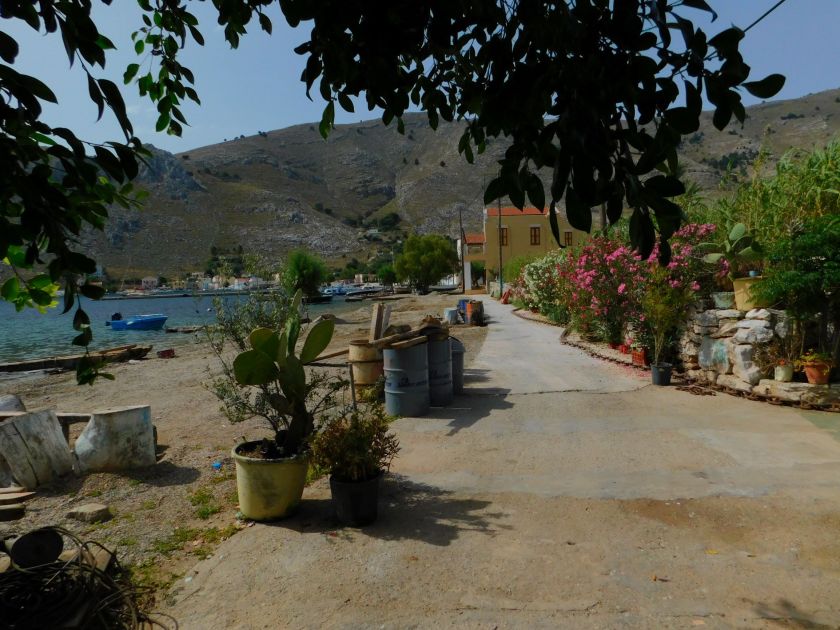
On one of my daily walks around Pedi bay I noticed how many tables there are by the sea.  Not formal taverna and restaurant tables but informal, quirky ones, put out by people who enjoy simple pleasures.  These photographs share some of them with you.  The one of the breaking waves gives you an idea of what the wash looks like when the Blue Star 2 ploughs past the entrance to Pedi on a calm day and there’s no wind to break up the wake.


Time moves in strange ways on Symi, possibly because we don’t work 9 to 5, Monday to Friday, with weekends to mark off the passage of time.  In the summer months most of us work 7 days a week and often evenings too, depending on what we are doing, and the weeks flash past.  There is plenty of time for days off in the winter, when the tourists have gone home and there is no work to be found.

The worst of the heat is probably behind us, as July draws to a close. The humidity is rising as the evenings grow longer and pockets of sea mist linger in the early mornings.  Temperatures are around 38 degrees centigrade at midday and around 28 degrees at midnight.

Symi found itself rocking to Sunday visits from a crowdfunded yacht flotilla company called the Bucketlust.  As they held a weekly fancy dress party at the Harani Club in Yialos the locals were agog to see what the young crowd were – or were not – wearing as costumes.  Whether this will bring a new generation of Symi fans remains to be seen.

An alternative kind of aquatic Symi holiday is offered by Strel Swimming Adventures .  They specialise in swimming long distances in beautiful locations and have recently added Symi to their portfolio, with the Pedi Beach Hotel as their base.

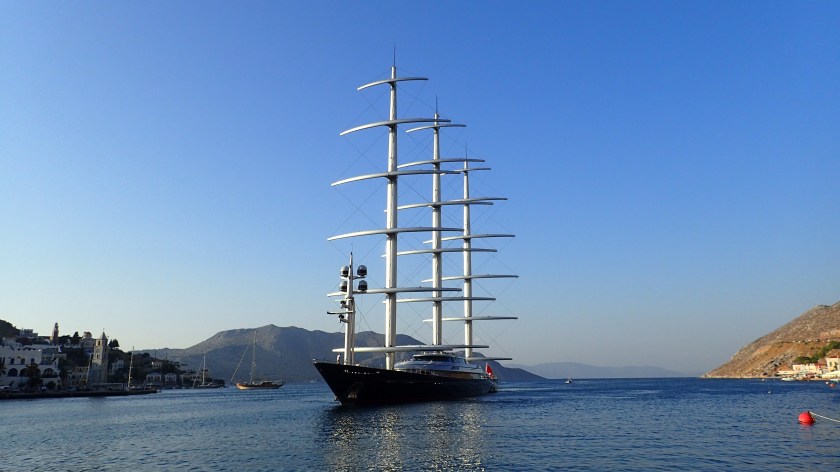
The Rodos Cup Regatta passed through Symi last week, bringing 537 sailors from 13 countries to Symi.  We were also visited by the highly distinctive super sailing yacht, Maltese Falcon,pictured below.

OLYMPUS DIGITAL CAMERA

A fabulous new portfolio of rental properties, Select Symi, has now been launched, featuring some seriously high end properties.  If you want a waterfront villa with 5 bedrooms with en suite bathrooms and a jacuzzi, this is the place to look.  Drool here!

The Symi Festival 2019 has been launched.  The program is available on Facebook and there are also random posters around the town, advertising events.  This is all in addition to the usual name days, weddings and baptisms that fill the July calendar.

The first fortnight of August are traditionally the busiest weeks of the year in the Mediterranean countries and Symi is no exception.  Athens is emptying out and the islands are filling up.


May Postcards from Symi

blog 7 May 2019 a
Symmetry
blog 7 May 2019 a1
The waterfront in Pedi bay is slipping into summer mode.
blog 7 May 2019 a3
Waiting for parasols
blog 7 May 2019 a4
The tiny church dedicated to St Thomas celebrated its name day this week.

blog 7 May 2019 a5

blog 7 May 2019 b
This stone wall next to Apostoli’s is turning into a work of art as the fishermen clean their paintbrushes on it and test that they have the colours for their boats mixed just right.
blog 7 May 2019 b2
Essential supplies – cases of beer and bottled water, waiting to be loaded onto a boat to be taken to one of the beach tavernas. The water taxis are still in the boatyards in Harani and Pedi so opening is a while off yet but it takes time to get stock out to places that can only be accessed by sea.
blog 7 May 2019 c
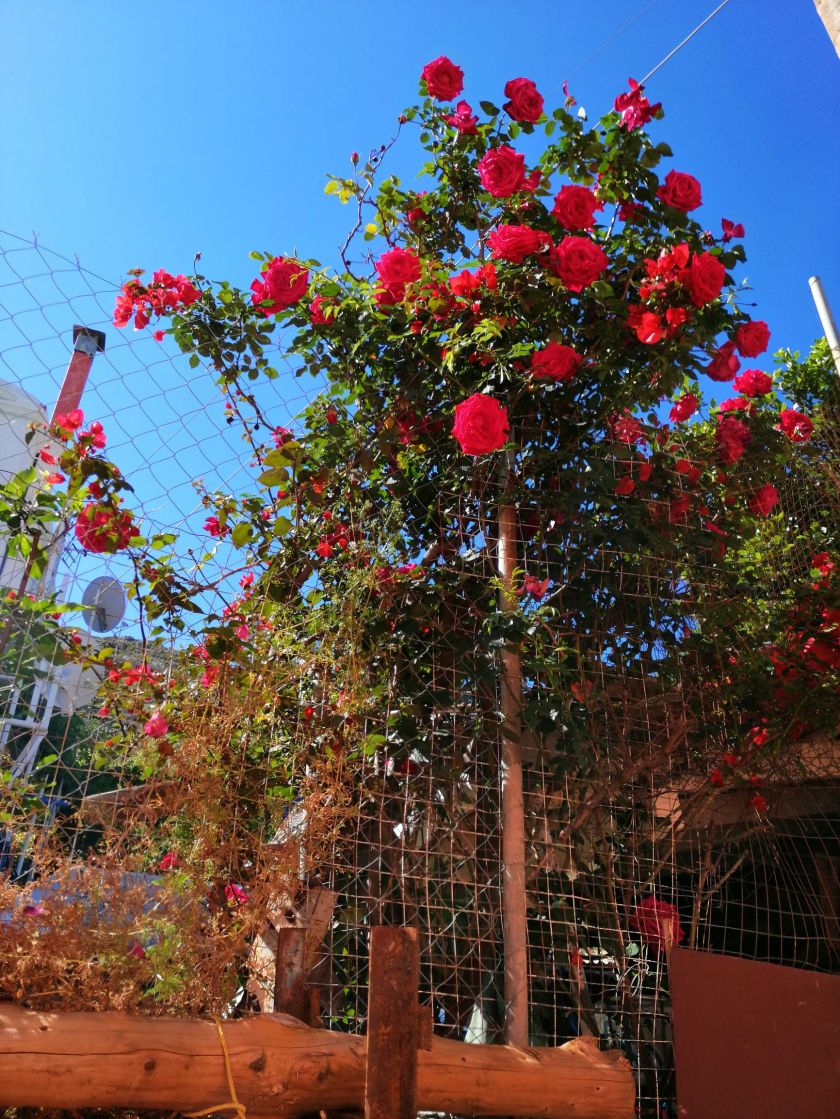
Roses flourish in sheltered gardens around Pedi and Chorio.
blog 7 May 2019 c2
Windows
blog 7 May 2019 d
In need of a little TLC.
blog 7 May 2019 e
The view from Evangelismos church in Harani, looking across the entrance to Yialos.  The Nireus and Aliki hotels are along the waterfront and the Merchant House is one tier up, above the Aliki. The green hills in the background are the south wall of the Pedi valley with the Vigla, the highest point on Symi, on the right.  
blog 7 May 2019 f
Outside bathroom
Eilish and Allen petunias
Pedi petunias

The Symi summer season starts later than it used to as fewer tourists come to Symi for Easter and spring break.  With little pressure, businesses now unfurl from the winter hibernation at a more leisurely pace and most set their targets for the end of May rather than the beginning.

Every day brings more changes, particularly in the harbour where the day boats from Rhodes provide more of an incentive for shops and cafes to open up but here in Pedi things are still very quiet.  The first Saga Holidays people have arrived at the Pedi Beach Hotel and the last bus is now at 9.30 p.m. from Pedi.  We had supper with friends at the newly re-opened Katsaras Taverna in Pedi and we were the only diners.

The weather is still unsettled, with random red rain showers, occasional blustery days and temperatures ranging from 16 degrees to 25 degrees.  Even on the hazy days of Saharan dust it can be very bright and the sun cream days are definitely with us.  Over the weekend there were countrywide ferry and flight disruptions due to strong winds.

Tomorrow is VE Day and a local holiday.  German General Wagener surrendered the Dodecanese to the Allies at the building on the waterfront in Yialos that now houses LOS club (previously Katerinettes pension and taverna).  There is still a big parade here on Symi every year.  When I first came to Symi, nearly 30 years ago, veterans and their families would make a point of coming to Symi to attend the parade.  Now they are long gone and very few of the people taking part or watching have any real first hand connection with the event.  It is still, however, an important part of Symi’s recent history and a reminder that tiny islands are not immune to the ripples of world events.

On the ferry front, ANES released a schedule for the Sebeco that covered the Easter and May Day holidays and runs out tomorrow, 8 May, so we still don’t know which evenings, if any, there may be boats from Rhodes to Symi or which mornings there will be boats from Symi to Rhodes. The promised extra Blue Star Sunday routes also don’t appear on any schedule. The Blue Star 2 made a diversion through Symi this Sunday past in order to pick up morning passengers from the Sebeco who would otherwise have been stranded as the wind was too strong for the Sebeco to run.  Generally speaking, if you are making plans, it is probably best to stick with what is on the Dodecanese Seaways and Blue Star websites and regard anything else as a bonus!

Symi Faces

A wide range of languages can be heard on the streets of Symi, including Mandarin and Hebrew in addition to the more usual Russian, French, Italian, German, Danish, Norwegian…

blog 2 June 2018 a_marked
Semi-detached Symi style.
blog 2 June 2018 b_marked
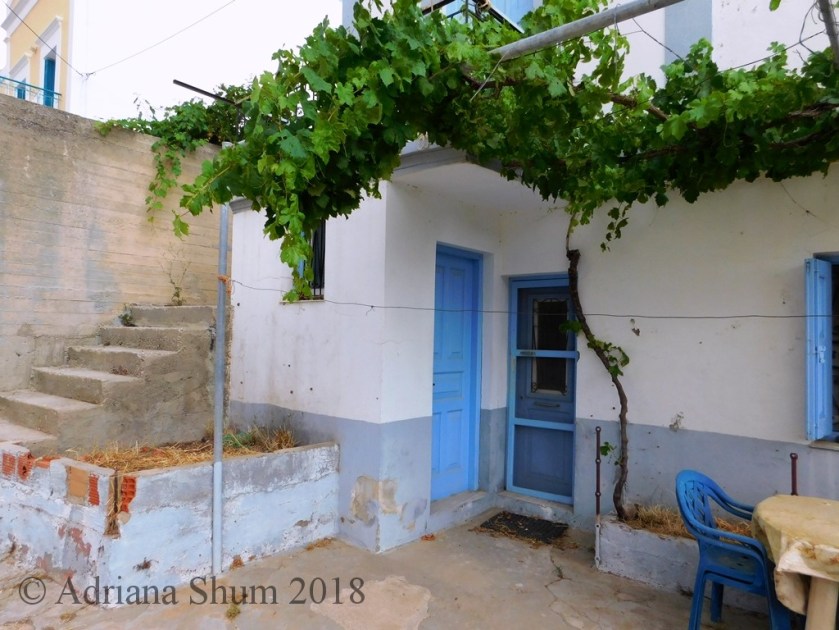
Generally speaking, Symiot village houses are not big – often just a kitchen downstairs with the rainwater cistern behind and then a salon above with a moussandra sleeping loft above that.  When flush loos and showers arrived in the 1970s, there was seldom space indoors for the plumbing arrangements so they were build on wherever they could fit.  It is not unusual to see facilities separate from the house or tagged on in the courtyard or even, in some cases, actually across the lane on a separate plot.
blog 2 June 2018 c_marked
Not quite en suite but it will do!
blog 2 June 2018 d_marked
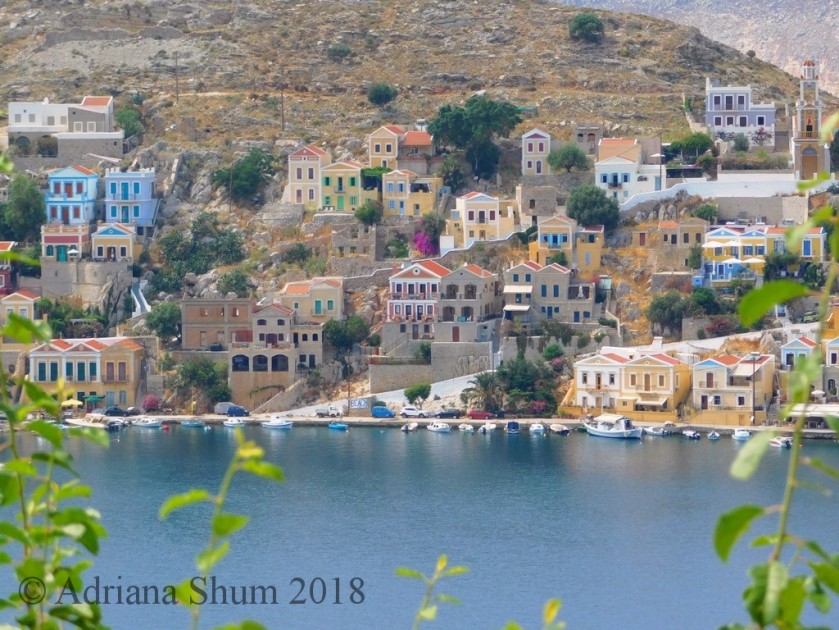
The Harani area of the harbour has become very built up in recent years.  Quieter than the main harbour during the busy months of summer, it is also one of the very few places on the island where one can live within walking distance of a beach.
blog 2 June 2018 e_marked
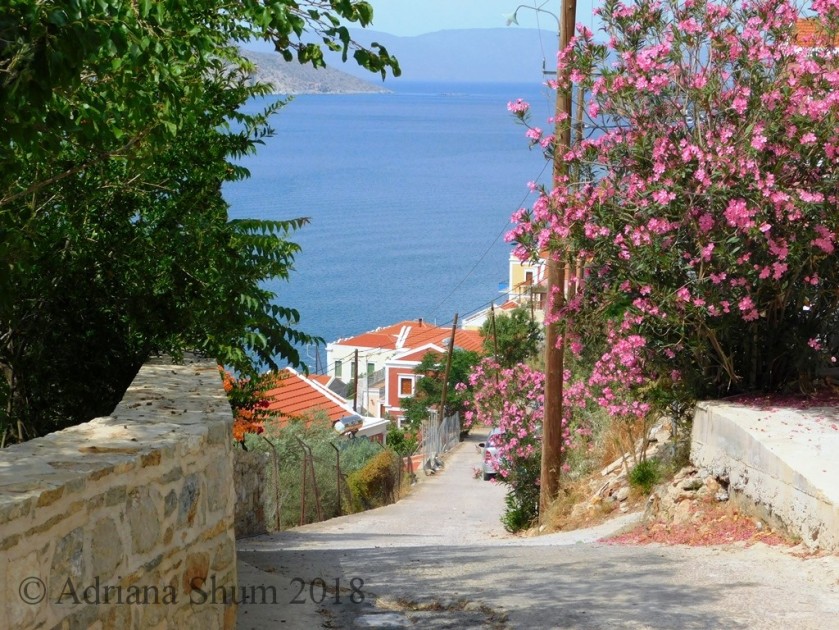
This narrow concrete track was the original motor road connecting Yialos with Chorio.  Apparently it was built by the Italians with motorbikes in mind and the angles of the zigzags are acute to say the least.  Chopped off when the new two lane motor road out of the town was built in the 1980s, one can still see remnants of the stone foundations of this original road up by the windmills.
blog 2 June 2018 f_marked
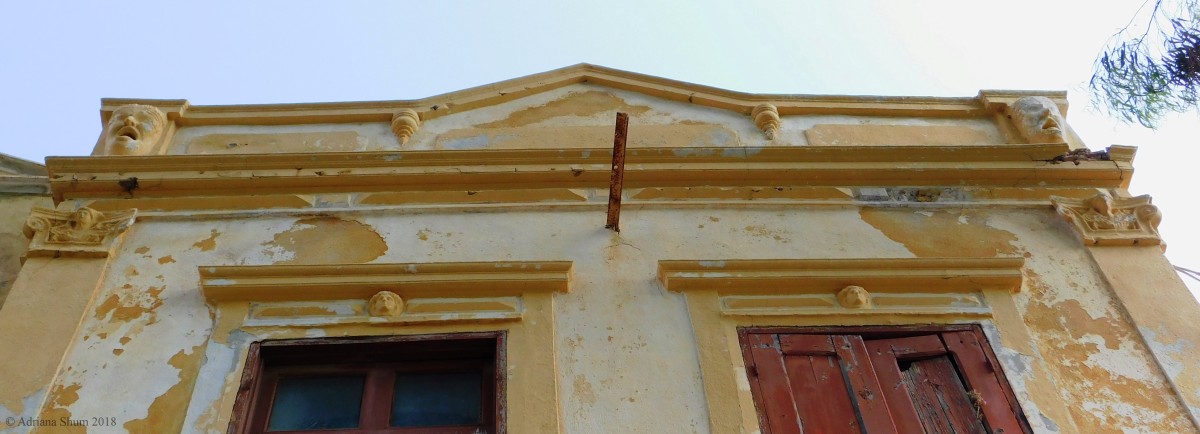
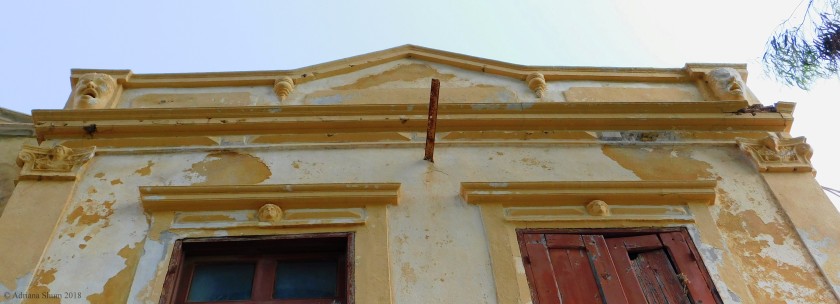
Now abandoned, this intriguing house on the Pedi road probably has the most ornamental faces on the island.  The winged Hermes/Eros motif also appears on the dentist’s surgery at the bottom of the Kateraktis lane at the back of the harbour.  The grimacing man is also a central motif on a pediment near Kampos in Chorio and several other houses in the area.
blog 2 June 2018 g_marked
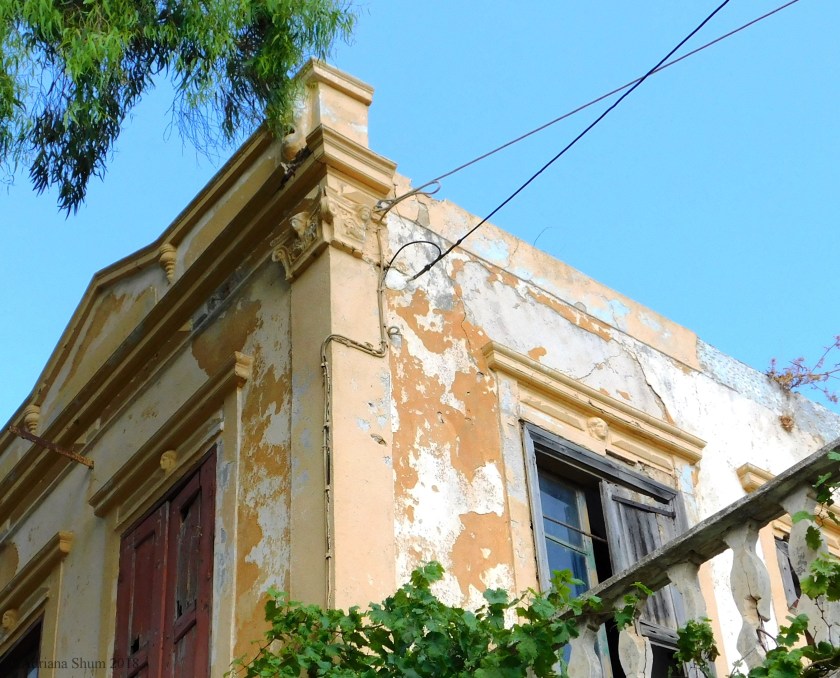
The faces even continue round the corner.
blog 2 June 2018 h_marked
A neighbour was not so extravagant.
blog 2 June 2018 i_marked
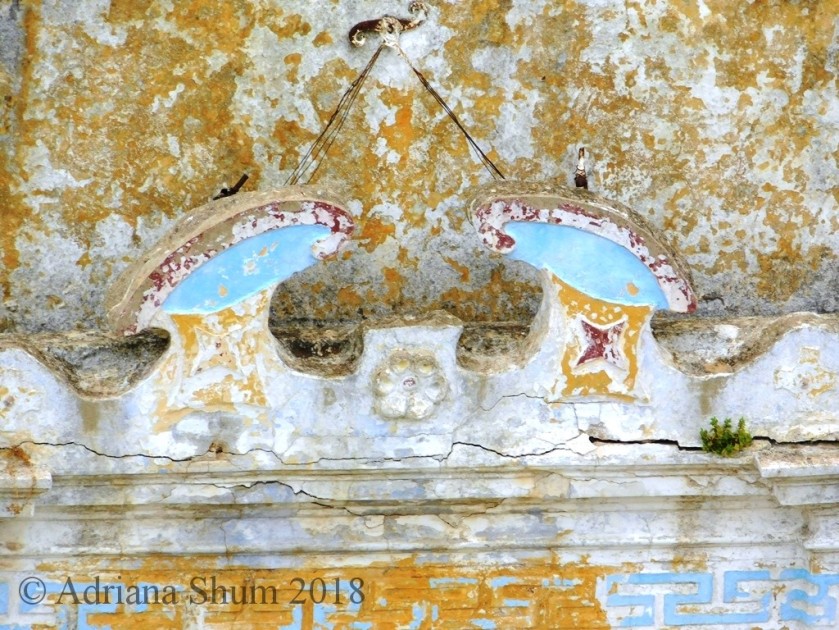
Stars and flowers above a door below the windmills.


June has arrived, hot and sticky with the rumble of far distant thunder storms over the embracing Turkish coast.  We actually had a couple of hours of steady light rain one evening earlier this week, enough to make the gutters drip and wash the dust off the citrus trees.  Every night we hear the desalination plant, squeaking away on the Pedi road as it frantically turns sea water into an approximation of the fresh stuff to keep our lavatories flushing and our showers running.  We had a lot of rain this winter but it came to an abrupt halt at the end of February and cisterns are emptying fast.

The water taxis are back in business. The beach tavernas are opening up, albeit with limited menus at the moment.  A wide range of languages can be heard on the streets of Symi, including Mandarin and Hebrew in addition to the more usual Russian, French, Italian, German, Danish, Norwegian…  There are still lots of British visitors around but they are no longer the dominant group they used to be.  June used to be referred to as ‘the English month’ on Symi.  Not any more. There’s a polyglot cosmopolitan vibe that used only to be in evidence in the high season months of July and August.

Have a good week.

Regards,

Adriana