A Winter Weekend in Patmos (Part 3)

At first light on the Saturday morning Nicholas set off on an exploratory run, up the kalderimi (traditional stone-paved donkey path) through the trees to Chora on the hill top.  The path was well-maintained, although slippery with moss and weeds in places.  There is a policy in place to replace the fire-prone alien eucalyptus trees with indigenous conifers and in between the scorched trunks of eucalyptus there were new saplings, protected by mesh and connected to an irrigation network.  Once again, absolutely no litter, not even in the water courses.

After breakfast at the hotel we went up to Chora together.  The monastery gates open at 8.30 and we got there about an hour later.  There was not a soul to be seen but the door was open so we went in.  As we stood in the main courtyard, looking round, a chap of about 40 came up to us inquisitively.  It subsequently transpired that his name was Andoni, that he has learning difficulties of some sort and that he was in sole charge that day.  He was not expecting to see tourists and it was just as well that Nicholas speaks good Greek as he was slightly intimidating.  Eventually he left us alone to explore, only occasionally popping up from a random doorway or tunnel to check that we weren’t committing sacrilege.  One drawback of visiting in the winter is that the museum, treasury and museum shop are closed, although this is not mentioned in any of the guide books and the locals, when we asked later down in the harbour, seemed surprised.  A phone call from our hotelier established that these days there are so few tourists in the off season that it is no longer worth paying staff to open up these facilities between October and April.  Hence Andoni, no doubt.

An advantage, on the other hand, was that we could wander about and soak up the atmosphere without too many obvious 21st century intrusions.  Speaking of 21st century intrusions, the public toilets were open and immaculate, not just in the monastery but also the municipal facilities.  Symi, take note!

As you can see the views from the rooftops are fantastic.  In my next instalment I will share with you some photographs of the windmills as well as the lanes we walked through to reach them.

By the way, we weren’t the only foreign visitors on the island that weekend.  There was also a young man from South Korea and a middle-aged woman from Croatia.  More about them later!


A Winter Weekend in Patmos (Part 2)

Our visit to Patmos coincided with the January full moon, as you can see from the above photographs. The featured image at the top is the view from our hotel room.  Whatever time of the day I tried to photograph it, the light was in the wrong place but you get the general idea!

Although Patmos is very rugged and hilly it is no where near as steep and arid as Symi. There are many valleys and watercourses, some of which have formed lagoons.  Apparently in earlier times these lagoons were used for salt harvesting.  These days they are more likely to be used as beaches in the summer months, with tamarisk trees planted in rows along the sand bars.

The gentler gradients mean larger terraces and a lot more agricultural activity.  Unfortunately it has also encouraged much more building all over the island so there is very little untouched landscape. The rich and famous, including the Aga Khan, have big estates on the island.  There is none of the hedonistic party vibe associated with Mykonos and although Patmos has some pretty beaches and great sunsets they are not as photogenic as Santorini so the focal point of tourism on Patmos tends to be religious rather than the usual tourist scene. This means that the wealthy enjoy a degree of privacy and seclusion.

It also means that there are some very upmarket shops, spas and boutiques down in Skala as well as a branch of AB Supermarket, one of Greece’s oldest surviving supermarket chains.  There is also a tiny branch of Jumbo, the well-known Greek toy and housewares chain, every bit as cluttered as the diabolical maze of the Rhodes branch but on a much smaller scale.

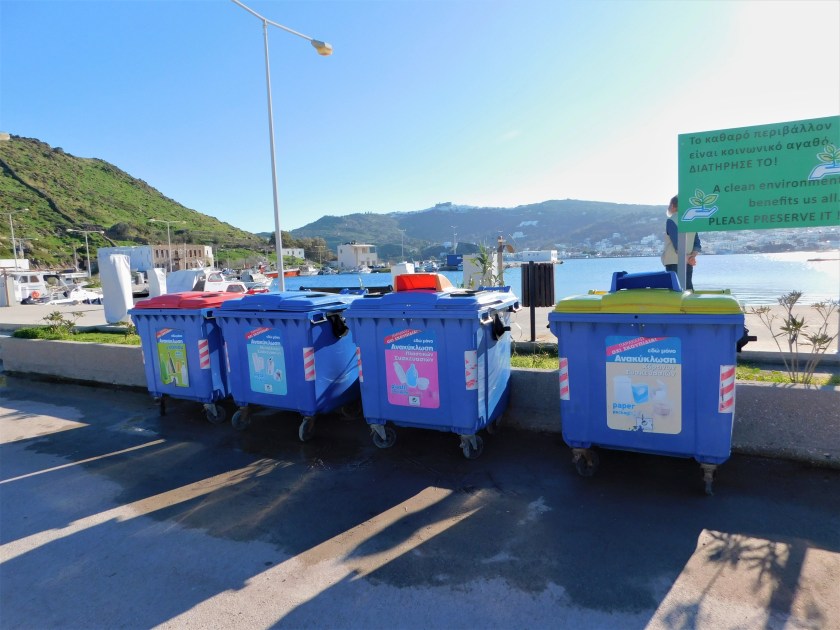
Patmos has a permanent population of around 3000 so not dissimilar to Symi.  The island was spotlessly clean and there were recycling bins absolutely everywhere.  Wherever there were refuse bins there were recycling bins so locals did not have to go anywhere special or do anything inconvenient to participate.  On inspection we noticed that they were being used correctly and although we drove from one end of the island to the other, we did not see a single plastic bag stuck in a sage bush or a trail of litter marking the location of a landfill.  Another thing we noticed is that the power station, located on the waterfront in the bay we walked around on arrival, is practically silent and unobtrusive as it is seawater cooled.

recycling in the harbour

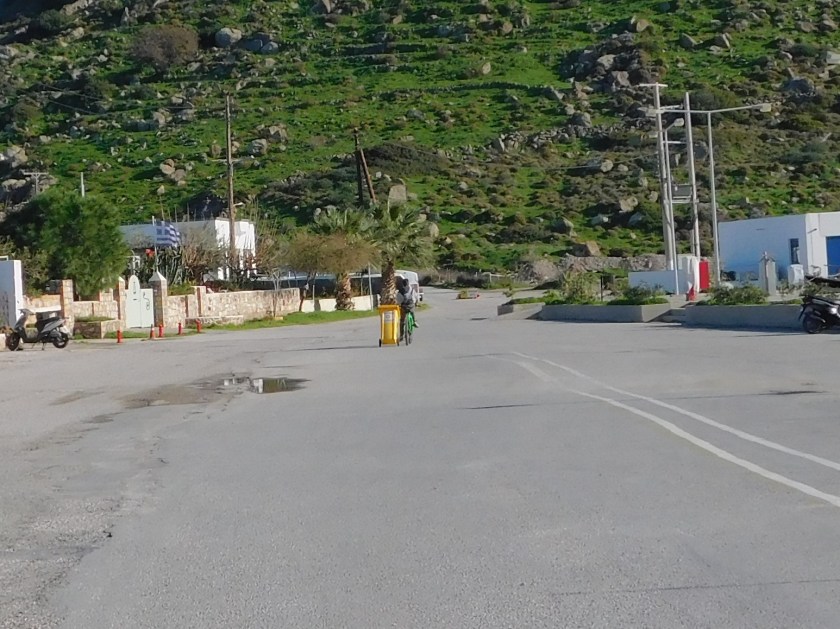
taking out the recycling
This lad is pedalling away on his bicycle, pulling a wheelie bin labelled aluminium.